











Dave Moulton

More pictures of my past work can be viewed in the Photo Gallery and on my Website. Links are in the navigation bar at the top

bikelaw - bicycle accident lawyers

Zero Tolerance for Spam

  I can delete Spam a lot quicker than it can be posted. Comments are checked daily, even on old articles, and any with irrelevant advertising links are deleted. Blatant or persistant Spammers are blocked. 

Dave Moulton


Powered by Squarespace
Monday
Feb182013

Vent Holes

I am sometimes asked, why are there tiny holes drilled in certain parts of a bicycle frame, like the ones shown on the left?

These are vent holes. During the brazing process the air inside the tube expands as it is heated. The vent hole allows the air to escape as it warms up and also allows for air to enter as it cools.

If the tube is totally enclosed, on cooling the air contracts sucking the molten brass inside the tube leaving a pin hole that is almost impossible to fill.

Worse still pressure can build up in an un-vented tube and hot brass can blow back in your face. Anyone not knowing this will soon learn the importance of vent holes after picking little globules of brass embedded in their face or finds little brass balls hanging like tiny Christmas Tree decorations from eyebrows, mustache or other facial hair

Vent holes are only needed when a tube is closed both ends like the example shown above. The top tube is closed at both ends and is usually vented with holes into the seat tube and head tube. (When the bike is assembled these holes are hidden.)

Seatstays are enclosed with a fork dropout one end and the seatstay cap at the top. The front fork blades are also  enclosed both ends between the fork crown and the fork tip or dropout.

Other tubes like the seat tube, down tube and the chainstays are open inside the bottom bracket shell. These tubes are not totally enclosed so do not need any additional vent holes; neither does the brake bridge because it has a brake bolt hole.

On some of my custom frames you won't see holes in the chainstay bridge like the one in the picture. They are hidden inside the bridge tube by drilling holes sideways through the left and right chainstay tube, before the bridge tube was put into place. Only one hole is needed for venting but often two holes are drilled for better drainage of moisture later.

The vent hole in the seatstays on my frames is on the inside up near the seat lug. You might have to turn the bike upside down to see it.

On my front fork blades I drilled one vent hole in each fork blade near the bottom, but after the fork was fully brazed and had cooled I went back and filled it by brazing a piece of wire in the hole. The heat generated in doing this was so small and the air space inside the fork blade was big enough that it did not cause a problem. This whole process only took a minute to complete.

I did this for two reasons. Front fork blades are highly stressed, so filling the hole eliminated a potential weakness at that point. Also rust needs oxygen, and with the fork blades completely enclosed and airtight, no corrosion inside is possible, even years down the road.

A small and probably unnecessary precaution, but one that took such a small amount of time, I always fugured, why not?


Monday
Feb112013

Running on Empty

A cyclist is somewhat unique in that he/she is both the passenger and engine. Like any engine it runs on fuel and when the fuel runs out the engine stops.

The fuel in this case is oxygen and carbohydrates, (Carbs.) and the muscles burn these as the cyclist turns the pedals. Oxygen is taken in automatically, but carbs in the form of the food we eat have to be taken in consciously.

Anyone who has been a cyclist for any length of time probably will have experienced the dreaded “Bonk.” Just as your car engine will splutter and stop when the gas runs out, run out of carbs and you will begin to feel weak, light headed, and the best you can do is creep along at a snail’s pace.

If you are alone and miles from anywhere that has food, you are in big trouble. If you have never experienced the Bonk, believe me it is an experience you would be better off avoiding.

Many of us are riding bikes to lose, or at least maintain a certain weight. Most people talk about carbs when taking on food/fuel, and calories when they are burning it. 1 gram of carbohydrate = 4 calories.

If we burn more calories than we take in we will lose weight. We won't lose weight even if we put in a lot of miles on the bike, if we over compensate our food intake for the amount we are burning.

As we gain fitness our rides become longer; it is no use thinking because we have a “Spare Tire” around our waistline this will sustain us on a long ride, something like the camel’s hump. It doesn’t work that way.

According to this article, we have in our bodies about 300 – 400 grams of carbs that we can draw on as immediate fuel, and riding a bike you are burning at least 100g of carbs per hour.

So we are good for a ride of 3 to 4 hours in duration without eating. If you are planning a longer ride, you need to look on the 300 to 400 carbs that you start out with as a reserve.

This 3 to 4 hours of available energy is not a precise amount like the capacity of a gas tank; it will vary from one individual to another.

Also a lot depends on the intensity of your ride; the faster you ride, the rate of calorie burn per mile increases because of greater wind resistance. (See the table on the left.)

Not only are you burning more calories per mile, but you are covering more miles per hour, and therefore you could be burning a lot more than 100 calories per hour.

Let’s say you plan to do a 6 or 8 hour ride; you will need to start eating around the first hour, and each half hour after that. The average energy bar is around 40 – 50 carbs, and it is unlikely you will eat a whole one every half hour. (Maybe half a bar.)

You will always be running on a deficit; burning more carbs per hour that you are taking in. Which is why it is important to start eating early and leave the 300 – 400 carbs you start out with as a reserve.

My usual Sunday ride is around 50 miles. I ride a moderate 15 mph average which means I am on the road for 3 1 /2 hours. (Give or take.) Before the ride I eat a bowl of oatmeal with fruit. I usually carry an energy bar with me, just in case. I usually can do this ride without eating.

This bears out what is said it the above linked article, that we are good for 3 to 4 hours. By the end of the ride I am close to being “Bonked” out but not quite. On arriving home I immediately eat something like a Greek Yogurt, and maybe a banana.

Also I find if I get started on my ride early enough that I can be back around noon, I can ride without eating. However, if I get a later start, because possibly it is too cold to start early; I will eat half an energy bar, halfway through the ride. It seems my body is used to having some nourishment around mid-day no matter what.

Rule of thumb is, if the ride is an hour or so you should not need to eat while riding. If it’s over three hours, take an energy bar or a banana or something, just in case. Any ride longer than four hours, plan ahead.

Eat plenty of carbs and drink lots of water the night before and on the morning of the ride. And carry enough food to get you though the number of hours you plan to be on the road. Start eating an hour in, and continue a little at a time throughout the ride.


Thursday
Feb072013

Bike Registry Picture Gallery

If I have been neglecting this blog in the past week it is because I have been updating my “Registry” website. I have recently rebuilt the entire site and this last week I added a Picture Gallery page with photos of bikes I built over the years.

Resizing all these pictures one by one and adding them to the webpage has been very time consuming.

But I have set the page up in such a way that I will now be able to insert new pictures as they come in, anywhere in the sequence.

This will mean that the pictures will remain shown in numerical succession listed by frame serial numbers.

If you hover the curser over the thumbnail picture the frame number will show up.

The registry has been up for about a year and a half now and it has 163 members.

It is interesting to note that many of the people owning bikes I built are the original owners. Most of the frames still have the original paint.

163 people listed is not many when you consider I built several thousand frames over the years, and I wonder where all the bikes are. However, there is hardly a week goes by that I get emails from owners who usually start out by saying, “I just stumbled upon your bike registry.”

It is probably a good thing that new membership to the listing is a steady trickle; after all I still want to find time to ride my bike.


Thursday
Jan312013

Mediocrity 

I sometimes feel our society is drowning in an ocean of mediocrity. Crappy TV, crappy music on the radio, and crappy movies shown at my local theater. Not to mention junk food being fed to us.

The sad thing is there is good music and good movies being made but you won’t hear it on your radio or see it at the theater. Why? Because music you have to really listen to fully appreciate, or movies that make you think, do not appeal to the masses.

Just as junk food gives a body instant gratification, so too does junk TV, music and Movies. And crappy TV and other entertainment is destroying people’s minds, just as surely as junk food destroys bodies.

The sugar or salt on junk food only gives a person fleeting pleasure while they are actually eating it. The moment they stop eating they are craving more.

So too with entertainment; people are constantly listening to music through ear buds because they are not actually listening, it is just background noise.

It is not difficult to eat healthy, it is not even expensive; it does however, require a conscious effort to research, choose and prepare the right food. It is not difficult to find decent entertainment either; it just takes a conscious effort to seek it out.

Some people might even find benefit if they removed the ear buds while running or riding their bikes and simply listen to the sounds of nature, or even just enjoy the silence. Plus they would have increased awareness of their surroundings, thus increasing their safety. 

About six months ago I dropped cable TV. I got tired of paying a premium for 150 channels and finding nothing worth watching.

I switched to Hulu and Netflix, and between the two I can pick and choose what shows I want to watch. More important I can watch them when I want to; I am not tied to the TV channel’s schedule. For example, I can watch the late night programs early the following evening.

It is one of the best things I ever did, it is costing me a fraction of what I previously paid for cable. And I have found there are some great movies being made that never make it to the movie theatre.

It is important to me what I feed my body and my mind.


Friday
Jan252013

Mike Moulton: Restored

Somewhere back around the end of 2005 I received an email from a Joe Cerone:

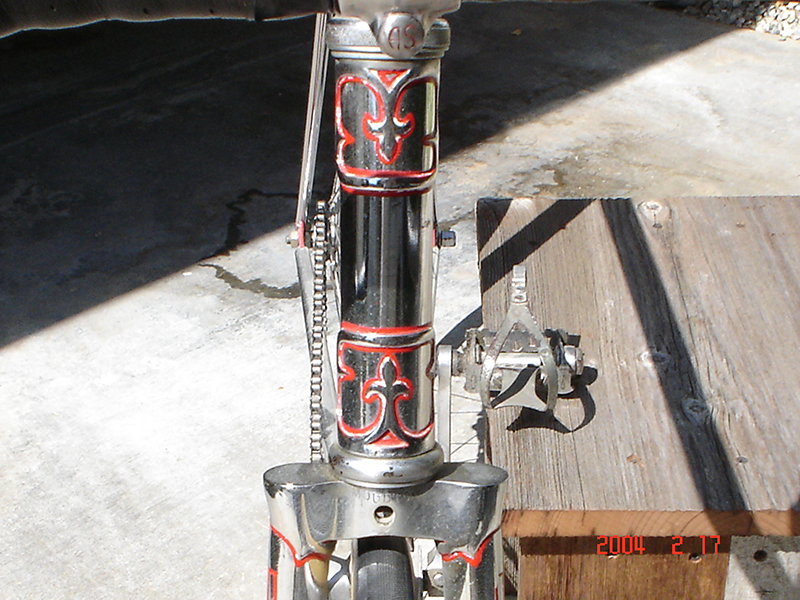
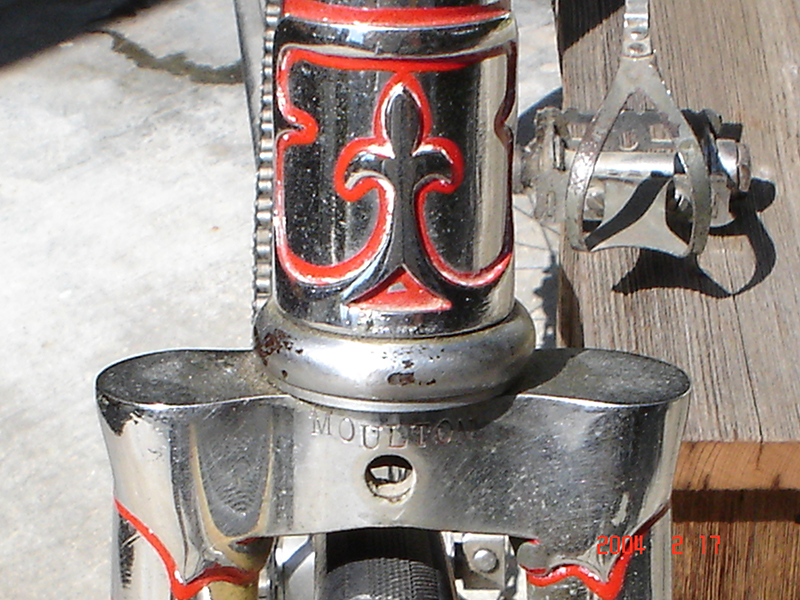
Sir: I have a bike that was custom made for me by a Lockheed Engineer by the name of Mike Moulton, his name is stamped on the fork.

He made this for me in 1949 and I raced it all over America as well as a member of the All American Team that toured Japan in 1951.

I won three California State Championships on the bike, 49,50, 51. Are you any kin to Mike?----Joe Cirone.

This was the first I had heard of Mike Moulton. We are not related but Moulton is a quite common English name. I later wrote an article here, and as a result I was contacted by Mike Moulton’s daughter and his nephew, unfortunately after I responded they never got back to me.

As Joe stated, Mike Moulton was an engineer at Lockheed Aircraft and started building frames as a hobby around 1947. 

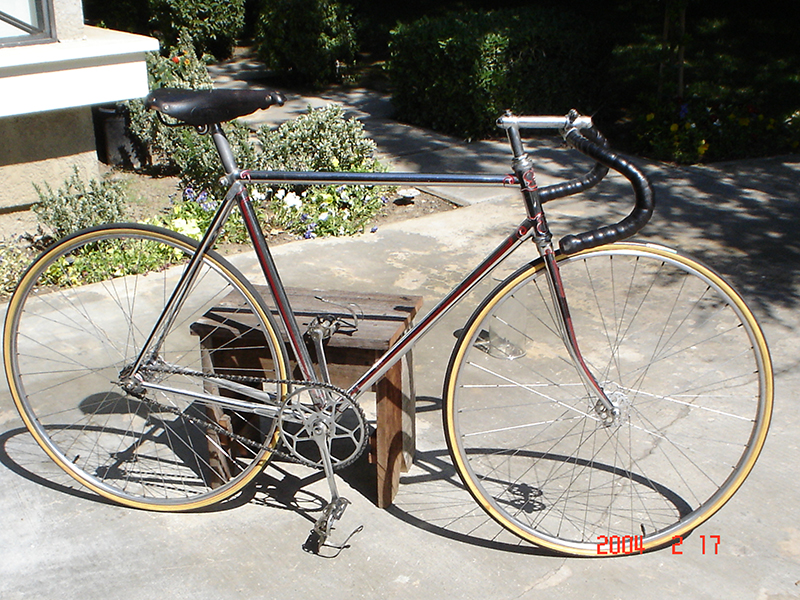
He built frames for about 4 years or so. The bike on the left is the one he built for Joe Cerone.

Los Angeles area cyclists raced on his bikes all around especially in those early years when the Burbank track was up and running around 1948/9.

Just this week I received an email from Jeff Groman who sent me pictures of a beautifully restored bike built by Mike Moulton in the mid to late 1940s. It was originally built for a rider named “Rusty” Baker.

The bike is built up with period correct parts including Airlite hubs, Chater Lea cranks, the handlebar stem is of unknown make. The bike will be displayed at Classic Cycles, Bainbridge Island, WA.

Although Mike Moulton only built a few frames as a hobby, he did so in an era when there were very few other American framebuilders. So this is a wonderful thing that Jeff Groman has done by restoring this bike. It is an important piece of Americana and American bike history.

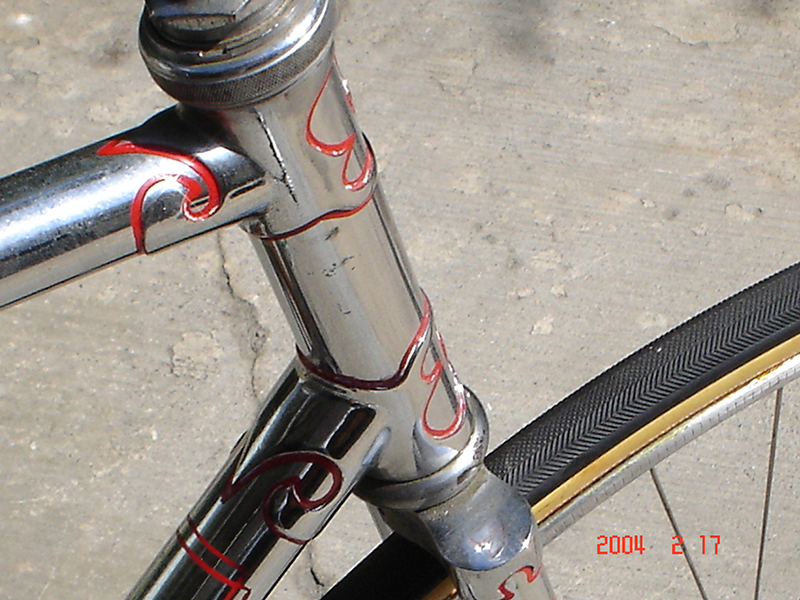
Mike would have had to get his materials mailed over from England. The lugs are Chater Lea cast steel. These were rough sand casting that required a great deal of hand filing, and were typical of those used by English builders in the 1930s and 1940s. The tubing is most likely Reynolds 531.


Below are pictures of the bike before restoration.